
Framework

A tool for exploring professional competencies across a broad range of ISL work.

Professional Pathways in Informal STEM Learning (ISL) was created to support professional learning for anyone who works in the ISL field. Science and technology centers and museums, natural history museums, children’s museums, zoos, aquariums, nature centers, botanical gardens, planetariums, and other types of museums and cultural organizations play a vital role in stimulating public interest and engagement in science, technology, engineering, and math (STEM). Each year, hundreds of millions of people explore and learn about STEM topics through exhibits, educational programs, and community events. The success of those experiences depends on the abilities of professionals like you.

To meet the complex and evolving needs of the ISL workforce, the ISL Professional Pathways suite of tools were developed with input and review from professionals across the field at all career stages. Whether you’re just starting out or advancing your career, the Framework, Self-Assessment, and Learning Plan can help guide your professional growth.

What is the Framework?

The Framework consists of four domains that cover the wide range of knowledge and skills that ISL professionals use in their work.
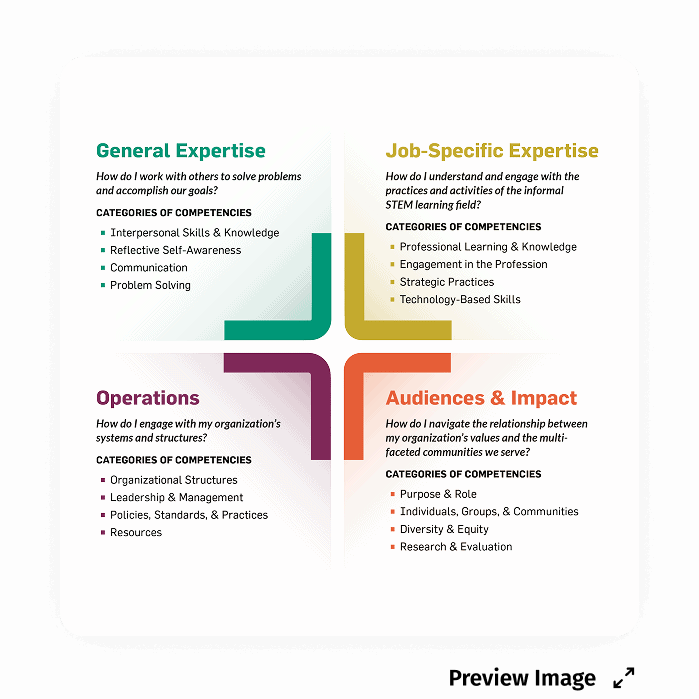
General Expertise
Job-Specific Expertise
Operations
Audiences & Impact
Each domain includes four categories, and each category contains three to five competencies. The order of the competencies does not indicate importance or level of difficulty. In total, the Framework includes 66 competencies that can help you better understand the skills and knowledge you use in your daily work.

Learn more about competencies and other Pathways language on the Key Terms page.

The Pathways suite of tools is designed to be flexible and adaptable to different contexts and environments. It does not suggest which competencies or levels of competency that you—or any individual—should achieve. It also avoids prescribing a single way that individuals learn or demonstrate their competencies. Most professionals will find that some competencies are particularly relevant to their position, aspirations, or circumstances, while other areas are not as applicable.

Framework

Explore the Framework below or download as a PDF.

General Expertise

These competencies describe the ways you align your daily work with the mission, values, and goals of your organization and understand the role of informal STEM learning organizations to engage audiences in equitable and impactful ways.

How do I work with others to solve problems and accomplish our goals?

Interpersonal Skills & Knowledge
GE.1
Develop and maintain effective relationships and collaborations.
GE.2
Manage disagreements and conflict constructively.
GE.3
Express and cultivate empathy.
GE.4
Recognize and respect differences in the ways individuals approach situations or problems.
Reflective Self-Awareness
GE.5
Reflect on personal values, attitudes, and ways of thinking.
GE.6
Consider how background and experiences influence biases and motivations.
GE.7
Recognize how others perceive and react to oneself.
GE.8
Hold oneself accountable for actions and their consequences.
Communication
GE.9
Express ideas and information in a clear and compelling manner.
GE.10
Align communication approach, format, and content with audience(s) and circumstances.
GE.11
Ask clear and relevant questions.
GE.12
Demonstrate active listening skills.
GE.13
Foster inclusive and constructive group dynamics.
Problem Solving
GE.14
Approach problems with resilience and persistence.
GE.15
Identify and analyze issues, problems, and solutions.
GE.16
Consider alternative approaches to problems and practices.
GE.17
Use a variety of techniques and strategies for solving problems.

Job-Specific Expertise

These competencies describe the ways you engage with the field, commit to professional learning, and strategically use your knowledge, skills, and technology in daily work.

How do I understand and engage with the practices and activities of the informal STEM learning field?

Professional Learning & Knowledge
JE.1
Understand basic STEM content and processes.
JE.2
Understand and apply principles of informal learning.
JE.3
Monitor and be responsive to practices that inform informal STEM learning work.
JE.4
Demonstrate a commitment to professional learning.
Engagement in the Profession
JE.5
Engage with professional organizations, networks, publications, and other resources.
JE.6
Use and contribute to the knowledge base of the field.
JE.7
Represent and promote the work of informal STEM learning organizations and the informal STEM learning field.
JE.8
Strengthen workforce capacity, retention, and satisfaction.
Strategic Practices
JE.9
Demonstrate project management skills and strategies.
JE.10
Identify and understand the purpose, goals, or objectives of programs, projects, and activities.
JE.11
Align planning, implementation, and assessment of projects, products, and services with goals.
JE.12
Demonstrate reflective and evidence-based practices.
JE.13
Adjust actions and priorities to achieve desired goals, outcomes, or objectives.
Technology-Based Skills
JE.14
Maintain proficiency in relevant technologies.
JE.15
Select and use appropriate technologies for communication and collaboration.
JE.16
Consider reliability, ethics, cost/benefits, and purpose when selecting technology-based tools or platforms.

Operations

These competencies describe how you contribute to the internal operations that support an organization or institution’s public activities. Workplace operations vary, so the ways that professionals demonstrate and develop operations competencies will likely be dependent on position and environment.

How do I engage with my organization’s systems and structures?

Organizational Structures
OP.1
Understand expectations and responsibilities associated with one’s position.
OP.2
Understand the purpose and functions of organizational units or departments.
OP.3
Understand and navigate internal and external management structures.
OP.4
Maintain, implement, or develop organizational protocols.
Leadership & Management
OP.5
Understand the skills and responsibilities of management and leadership.
OP.6
Provide vision, oversight, or support for projects, activities, or initiatives.
OP.7
Strengthen the capacity and cohesion of teams or staff.
OP.8
Promote staff well-being and satisfaction.
OP.9
Consider the broad and long-term implications of actions.
Policies, Standards & Practices
OP.10
Inform decisions and actions with relevant policies, standards, and ethical guidelines.
OP.11
Uphold employee rights, responsibilities, and policies in the workplace.
OP.12
Maintain, implement, or develop policies, standards, and practices.
OP.13
Support and advocate for policies and practices that advance informal STEM learning efforts.
Resources
OP.14
Identify, monitor, and steward resources.
OP.15
Develop or implement strategies and practices to increase efficient use of resources.
OP.16
Understand and apply budgeting, accounting, and other fiscal management concepts.
OP.17
Select and maintain resources to promote long-term organizational sustainability.

Audiences & Impact

These competencies describe the ways you align your daily work with the mission, values, and goals of your organization and understand the role of informal STEM learning organizations to engage audiences in equitable and impactful ways.

How do I navigate the relationship between my organization’s values and the multi-faceted communities we serve?

Purpose & Role
AI.1
Understand the characteristics, purposes, and distinctions between mission, vision, and goals.
AI.2
Align actions and decisions to promote the organization’s mission, vision, and goals.
AI.3
Identify and respond to priorities within the field and communities.
AI.4
Monitor and be responsive to different perceptions of the changing role of informal STEM learning organizations.
Individuals, Groups, & Communities
AI.5
Understand and respond to the interests, and priorities of communities and audiences.
AI.6
Develop and implement practices that expand and enrich audiences.
AI.7
Develop and sustain equitable relationships and collaborations with and across community groups and organizations.
AI.8
Shape efforts to strengthen audiences’ experiences and address community and societal priorities.
Diversity & Equity
AI.9
Understand the language, goals, perceptions, and practices associated with equity and diversity in the informal STEM learning field.
AI.10
Advocate for practices that are fair, transparent, and bias-free.
AI.11
Embed diversity and equity principles into all practices.
AI.12
Pursue actions that diversify the informal STEM learning workforce.
Research & Evaluation
AI.13
Understand the purpose and value of research and evaluation.
AI.14
Select and use appropriate research and evaluation products.
AI.15
Contribute to and support research and evaluation efforts.
AI.16
Promote research and evaluation products and processes.

What's next?

As part of the Pathways suite of tools, the Self-Assessment will help you connect your experiences to competencies and identify areas you want to develop.

NSF-Logo.png


This material is based upon work supported by the U.S. National Science Foundation under Award No. 2215274. Any opinions, findings, and conclusions or recommendations expressed in this material are those of the author(s) and do not necessarily reflect the views of NSF.

Scroll to Top