
Science Centers and Public Engagement with AI
Creating pathways for public understanding, participation, and influence in AI
Artificial intelligence is rapidly changing our world, yet there is a significant gap between AI’s growing societal influence and public understanding or agency. Nearly three-quarters of Americans say it is extremely or very important for people to understand what AI is, and about six-in-ten (61%) say they would like more control over how AI is used in their lives (Pew Research Center, 2025).
The Role of Science and Technology Centers and Museums in AI Public Engagement
Building on work already underway in education, governance, and other sectors, science and technology centers are well-positioned to help bridge this gap. AI’s complexity demands cross-sector collaboration, and science and technology centers and museums (SCMs) bring something essential: trusted spaces where people can both understand AI and shape its future. Through partnerships, SCMs can build public understanding while creating real pathways for meaningful participation in AI decisions that affect communities. As trusted institutions with expertise in making complex science accessible, SCMs can provide:
- Opportunities to learn about AI honestly – understanding how it works, where it’s already embedded in daily life, and what it can and cannot do
- Support to navigate AI safely and use it appropriately – protecting privacy, identifying misinformation, making informed choices
- Platforms for members of the public to question AI’s impacts and voice concerns
- Pathways to influence AI development, policy, and governance (an emerging and critical role)
- Forums to explore AI’s cultural meaning and process how it’s changing work, creativity, and daily life
Many science centers are already engaging with AI in their communities. ASTC supports these efforts through frameworks, resources, and peer learning opportunities.
A Framework for Action
To provide a roadmap for science centers and a framework for cross-sector partnerships, ASTC has developed a practical typology identifying 13 distinct roles science centers can play in AI public engagement, organized into four groups. This work prioritizes partnerships that increase public agency while maintaining SCMs’ independence and credibility as trusted community institutions.
Most SCMs are beginning with foundational AI literacy work (Group A) and building toward more complex partnership and advocacy roles over time.
Building Awareness and Knowledge about AI
- Role A1. Create opportunities for exploration and hands-on learning about AI
- Role A2. Help people navigate AI’s impact on employment and careers
- Role A3. Grow community capacity to use AI for their own purposes
- Role A4. Help people navigate AI safely and securely
Facilitating Public Input into AI Development
- Role B1. Facilitate public input into AI policy and governance
- Role B2. Get the public involved in shaping and contributing to AI research
- Role B3. Facilitate public input into AI system and product design, development, and demonstration
Strengthening AI-related Processes and Infrastructure
- Role C1. Support formal education in AI implementation and strategy
- Role C2. Enable public participation in AI-in-society networks or coalitions
- Role C3. Advocate for AI in the public interest
Exploring AI's Social Impact and Meaning
- Role D1. Provide space for grappling with the societal impacts of AI
- Role D2. Explore AI and culture through creative expression
- Role D3. Generate data and evidence about AI’s impacts and public perspectives
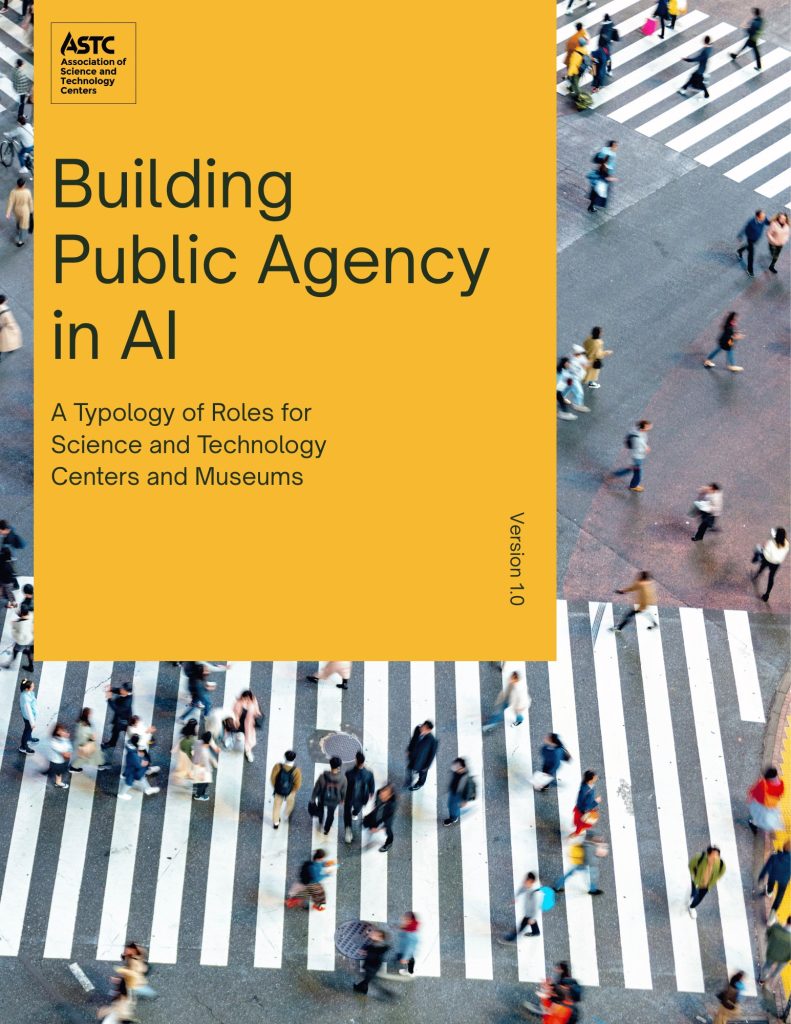
Explore the full framework report, including typology of roles and guidance for implementation. The typology is designed as a living document that will evolve as science centers implement these roles and as the AI landscape changes.
With support from the National Science Foundation’s Responsible Design, Development and Deployment of Technology (ReDDDoT) program, ASTC convened cross-sector leaders from science centers, AI industry, academia, government, and civil society to develop this framework collaboratively. This work is part of ASTC’s broader commitment to helping science centers respond to rapidly-evolving technologies.
Get Involved
For science centers and museums – Whether you’re already doing AI engagement or just getting started, explore the range of possible roles, identify what aligns with your mission, and connect with resources and peers.
For researchers, developers, policymakers, funders, and other potential partners – Understand what SCMs uniquely offer as partners in responsible AI development and identify opportunities for collaboration or investment in this work.
- Join our community of practice
- Contact us about partnership opportunities
- Share your AI engagement work
Group A: Building Awareness and Knowledge about AI
Building public knowledge and skills for AI literacy and agency
Group B: Facilitating Public Input into AI Development
Bringing public input into AI research, design, development, and regulation
Group C: Strengthening AI-related Processes and Infrastructure
Building institutional capacity, networks, and advocacy for the public interest
Group D: Exploring AI's Social Impact and Meaning
Understanding and making meaning of AI’s role in society through dialogue, culture, and evidence
- Join our Community of Practice
- Explore professional development opportunities
- Contact us about partnership opportunities
- Share your AI engagement work
Resources & Tools
Quick overview of all 13 roles
Complete framework with implementation guidance
Workshops and learning opportunities for SCM practitioners
Connect with peers doing AI engagement work
Case studies, self-assessment tools, and practical resources
For Science Centers & Museums
Whether you’re already doing AI engagement or just getting started, explore the range of possible roles, identify what aligns with your mission, and connect with resources and peers.
For Researchers, Developers, Policymakers, Funders, and other Potential Partners
Understand what SCMs uniquely offer as partners in responsible AI development and identify opportunities for collaboration or investment in this work.